A request in plain English comes back as a finished audience, a plan for where to reach them, and a brief for the ad creative — the whole marketing plan, all at once. That's because Intelafy has already scored every person in your data on every trait, on one comparable scale.
Intelafy has no data of its own — you bring the data, and its engine, the Brain, does the measuring. It works best when that data is already rich, so the best fit is teams that already pay to use large datasets about people: a market-research survey, a licensed audience dataset, or records of what people do online.
Companies that sell data can put the Brain inside their own product, turning their data into ready-made, sellable audiences — so their customers get finished scores instead of raw data to figure out. Intelafy already works this way with a national data provider, doing the audience scoring behind their platform.
Already pay to use a market-research survey or a record of what people do online? Point Intelafy at it and a brief written in plain English comes back as a super audience, a plan for which channels to use, and a direction for the creative — the whole marketing plan in one file.
Want to use your own customer data? Your own customer records go into a dedicated walled garden only you can see and are measured on the same 0–1 scale — so purchases, customer history, and wins and losses become comparable scores you own.
Not ready to talk yet? Start with a real session, see exactly what you get back, or read the technical case in full.
Watch a seven-word request become a nationwide audience, four segments, channel and creative plans, and a competitive map — in one afternoon.
The single file you get back — every person scored for who they are, how to reach them, what to offer, and which rival could tempt them away.
The technical case behind the method — explainability, one comparable scale, compliance by construction, and measured, not trained.
Both an AI catalog assistant and Intelafy let you type a request and get an audience back. The AI chat part isn't the difference. The difference is what each one draws on to build the audience — the names on the data, or the measured behavior of everyone in it.
Suppose a dataset never uses the word "sneaker" and files the whole category under a label like "athletic footwear." A tool that searches for the exact word finds nothing, and a broader search for "shoe" returns so many unrelated results that the useful one is hard to pick out.
The Brain understands what "sneaker buyers" means no matter what the dataset calls it, finds the underlying survey data, and scores an audience across everyone in the file. It also shows the options it considered and set aside, and why:
I spent years at Acxiom, building audience platforms the way the whole industry still does — thousands of models, one trained for every trait. I came away convinced that approach is structurally flawed, with no patch that fixes it. So I started Intelafy to do it the other way around: measure how everything relates, once, instead of training a model for every question.
The newer twist, fast becoming the industry standard, is bolting an LLM onto a data catalog. It's not AI — underneath, it's still a dictionary and a stack of trained models. Rather than fix the wrong approach, it doubles down on it.
The Brain measures how every trait relates to every other trait across everyone in the data — using fixed statistical math, not an AI model trained to hit a particular target. The same data always produces the same scores. So when you ask for an audience, the answer already exists. Building a new audience just means writing a definition and recalculating — a few days, not a months-long modeling project.
A 0.72 for “likely to buy an electric car” and a 0.72 for “likely to open an email” mean the same strength of evidence — so you can compare, rank, and combine them directly.
Raise the cut-off → a smaller, more precise audience. Lower it → more people. Same ruler, your choice.
Why does this make my data more intelligent?
Raw data is a pile of disconnected fields — columns that were never meant to be read together. Intelligence is structure: the relationships between them. Intelafy turns your data into a relational space you can question — every attribute measured against every other on one scale. A super audience is that intelligence made visible: traits that were never designed to be combined, fused into a single scored audience you can act on.
So "making data intelligent" isn't a smarter model bolted on top of your data — it's your data itself, made relational, comparable, and answerable.
Most audience data answers one question: who qualifies. A super audience answers the next four — for every individual person, not just the group as a whole. Each person comes scored for how to reach them, what to offer them, why they buy, and which competitor might tempt them away. The same 0–1 scale runs across every column.
| Person | Audience | Streaming | Social | Direct mail | Best offer | Motivation | Switch | Leans toward |
|---|
Example rows; the numbers are for illustration. Every column shown is a real, orderable score.
And you get two things: the scored file, and a ready-to-present slide deck built from the same scores — who the audience is, which channels to use, what to offer, and which competitors' customers to go after. One file does the job of the audience list, the media plan, and the creative brief at once. Because the detail goes down to each person, so does every decision.
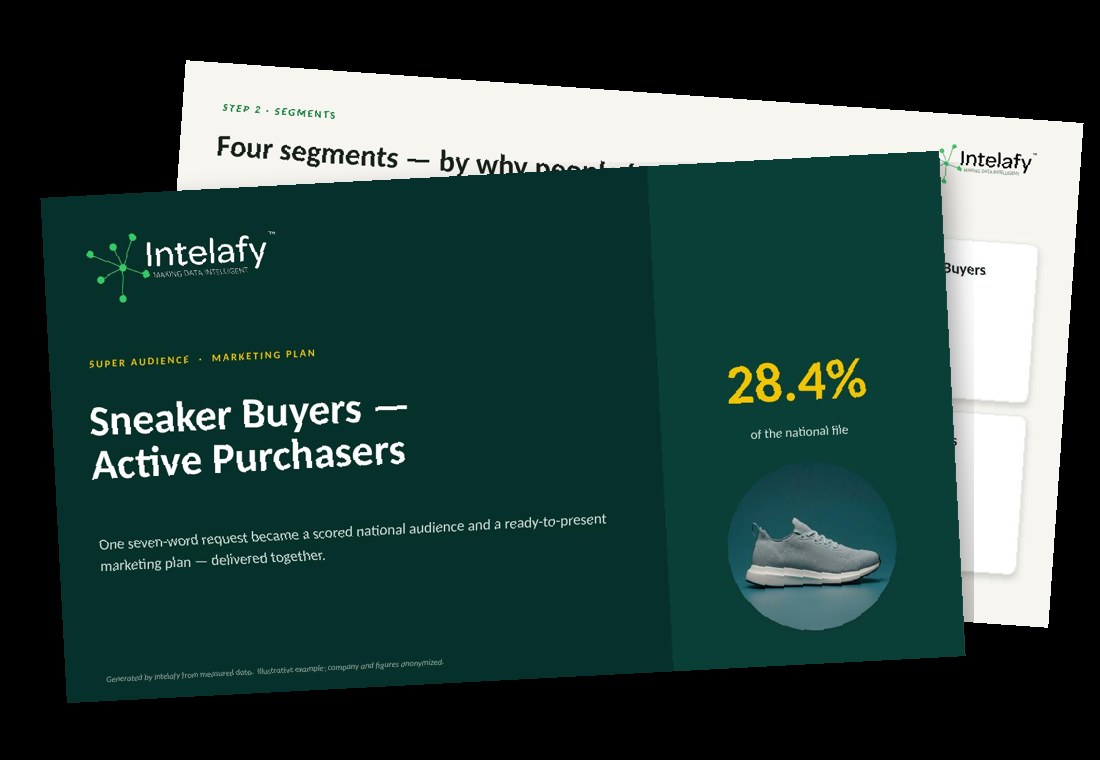
The sneaker plan above, exported the way the engine returns it alongside the scored file — audience, four segments, channel and creative plans, the competitive map, and the scored-file breakdown. Illustrative; figures anonymized.
Download the sample deck (PPTX) →Point Intelafy at the market-research survey data you already pay for, and your team can build audiences just by chatting with it. Here's what one full session looked like: an analyst typed a seven-word request, and a handful of messages later they had a nationwide audience, four segments within it, a plan for which channels and what creative to use for each, a five-tier map of the competition, a deep-dive on one brand prompted by a challenge from the analyst, and a creative brief for each segment.

Nothing to file and wait for. No AI model to train. No code to write. The session below is a real client session, with the company and its numbers anonymized.


It didn't back down and start over. It showed where the brand already appeared in more than one tier, explained the apparent contradiction, then turned the challenge into the most useful result of the session: a brand deep-dive no one asked for, ending in a complete super-audience plan covering both segments. The details below are anonymized.


The analyst started with a seven-word request and finished with a creative brief for each segment — plus everything in between: the audience, the segments, the channel and creative plans, and the competitive breakdown. Other approaches break down somewhere along the way: a basic search tool can't get past the first step, and a traditional AI setup would need a separate build for each new request. What holds a session like this together is the measured data underneath it.
A flat list tells you who. A super audience tells you who, why, how, and with what words.
— because every trait is a score on the same ruler
Measuring relationships directly — rather than training a separate AI model for each trait — is what gives the data all six. Together they make an audience that arrives ready to act on: comparable, explainable, stable, and complete down to the person.
Every trait lands on the same 0–1 scale, so you can compare, rank, and combine them directly. Each person is a complete, easy-to-read profile.
With a separate model per trait, one model's 0.72 and another's 0.72 mean different things — you can't compare or combine them without recalibrating first.
You define audiences as plain arithmetic on the scores — rank, threshold, and blend traits directly, with no step to reconcile scales.
Build an audience from any mix of traits in one move, and read every person as one comparable profile.
Scores come from measured relationships, not an AI model trained to hit a target. Same data in, same scores out — no drifting from one request to the next.
A model fitted to a target drifts when it's retrained, so the same person's score moves — and you can't tell whether people changed or the model did.
Results stay attributable: when a number moves mid-flight, it's the campaign, not the yardstick — so you optimize on signal instead of noise.
A stable baseline you can hold across a flight and compare across flights.
When data is missing for some people, it's filled in using the patterns across everyone — so the result always covers 100% of people, and no one is penalized for a blank. The depth of a survey (asked of a few) is extended to everyone, with thousands of traits scorable per person.
Trained scores go blank where data is thin — coverage gaps you often find only when an audience comes back too small to use.
You size and activate against the whole population, not just the well-covered slice — no silent shrinkage between definition and delivery.
Extend a survey asked of a few to everyone, with thousands of traits scorable per person.
No personal identifying information is needed, and when protected data is left out, it's truly absent from the scoring — something you can prove, not just promise. Transformations are designed to be compliant with fair-lending rules (FCRA / Reg-B) and can be tailored to each company's definitions. Every score keeps a record of what evidence produced it. Compliance depends on your data, use, and counsel.
Dropping protected fields before training doesn't remove them — proxy variables reconstruct them inside the model. Excluding them before scoring makes their absence structural.
You can show, not just assert, what did and didn't inform a score — the audit trail is the score's own record of evidence.
Audiences built for regulated use. Whether any specific use is compliant depends on your data, your use, and your counsel.
The same person keeps the same score for the entire length of a campaign. When results change, it's because the campaign changed — not the way things are measured.
When the yardstick moves between requests, you can't separate a real change in people from a change in the model.
Mid-campaign lifts and drops read as campaign effects, not measurement wobble — so your tests actually conclude.
Clean before/after reads and honest experimentation on a fixed baseline.
Start from any trait and get everything else ranked by how strongly it relates — each match explained by the evidence behind it. True substitutes tend to surface as substitutes. Which brands read as rivals depends on your file.
The ranking is built in — no separate similarity model to train, and every match carries the evidence behind it.
Expansion and look-alikes arrive with a reason for every match, so you can defend who's in and who's out.
Competitor read-across from any starting point. Which brands read as substitutes depends on what's in your file.
Intelafy has no data of its own — it's the engine. Point it at data you license, your own customer data, or both. Each setup is its own walled garden that only you can see, under the same privacy exclusions and access controls.
We build the audience and score every person in it — who's in, which channel, what offer, their motivation, and which competitor they lean toward — plus a ready-to-present slide deck. Delivered within five business days.
You supply the records — your customer list, prospects, any set. They come back with scores added for whatever traits you need — as few as one, or a full profile.
Your own private version of the Brain, measured across everything licensed data brings plus everything you add — purchases, customer history, wins and losses. Your scores genuinely change, and stay on the same comparable scale.
Give us a starting group — customers, survey respondents, any segment — and we score everyone else for how similar they are, with a reason for each match. The starting group's own defining data is left out, so matches are found on independent evidence.
Tell us what data you license and what campaigns you run. We'll show you the audiences you could build, the scores you could add, and the questions your team could be asking — all from your own private version of the Brain.