
The super audience.
An audience tells you who. A super audience tells you who, what, why, where, and how, in a single file and on a single scale.
The standard audience deliverable is a list of identifiers. It answers "who." Everything else the marketer needs (the media plan, the creative brief, the motivation analysis) arrives as separate studies from separate vendors, each in its own deck. This paper describes the super audience: a single person-level file in which comparable 0-to-1 scores for behavior, motivation, channel, and creative sit alongside membership, which turns four deliverables into one and makes the audience itself the plan. It is the practical form of a simple idea: every prospect is an audience of one.
The list-and-deck economy.
A targeting file answers one question well: who is in the audience. The moment you want to act on that audience, the work begins: a third-party append for channel propensity, a segment study for motivation, a creative team briefed on the persona. Each lives on its own scale, in its own format, reconciled by hand. The audience is the start of the project, not the deliverable.
Every prospect is an audience of one.
The super audience makes every prospect an audience of one: a person rather than a segment or a persona, with their own message, their own channel, and their own offer, each measured for that person and comparable on a single scale.
Personalization has promised this for twenty years. Two things held it back: the scores behind it were not comparable across categories, and they did not hold still. A model retrained between campaign flights reshuffles the very people it ranked last quarter, so no one could tell whether the campaign worked or the audience changed.
Every person, their own puzzle.
Because every attribute is comparable on the universal scale, a super audience assembles each person from their own mix of pieces (membership, motivation, channel, content), and every piece can be read against every other. Each prospect holds their own puzzle. A person is not described by their segment; the individuals define the segment.
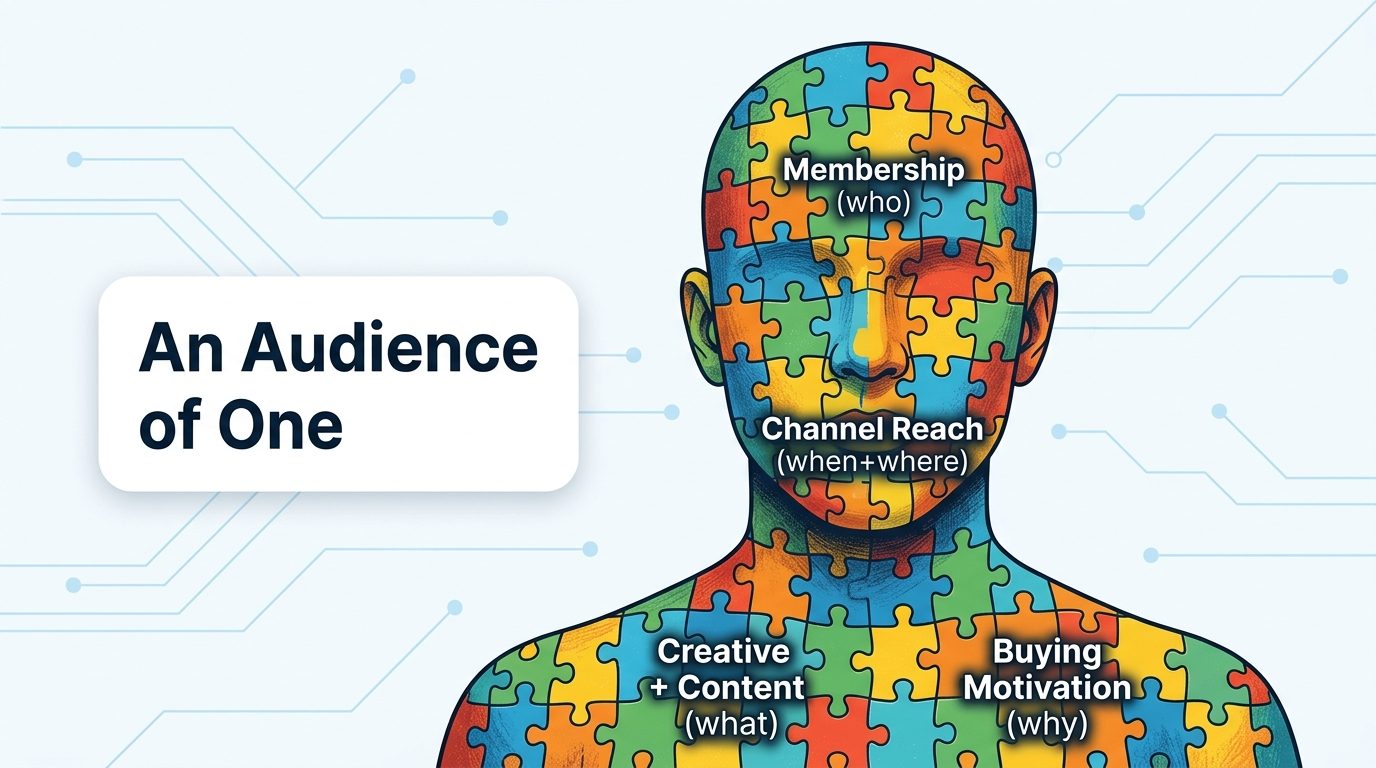
The puzzle has more pieces than the figure shows. For a named brand's campaign, offer fit scores on the same 0-to-1 scale, and so does competitive lean, the rival brands each prospect tends toward. Conquesting a rival's customers stops being a separate study and becomes a filter on the file you already have.
What one ruler buys.
At 0.25 on the universal scale the evidence is neutral; above it the evidence leans toward yes, and below it toward no (Paper 02). A 0.72 for connected TV and a 0.72 for email carry the same strength of evidence, so a media buyer can rank channels against each other, and against offers, messages, and audiences, without translating between vendors' private scales.
A common scale also lets you subtract. When every channel score sits on the same ruler, the prospects below 0.25 on a channel are visible before the plan is written, and they can be pruned before a dollar is committed (Paper 07).
The spend a plan can move off a channel is the number of people it pays to reach there, times the cost per contact, times the share of those people who score below 0.25 on that channel. Only the share comes from the scored file. The file size and the cost are the client's own, so the result is the client's number, and waste that hides between decks becomes visible inside one file.
A ruler that holds still.
The super audience is measured, not trained. The engine computes how attributes relate across the client's full population and scores each person from those measurements. Identical data yields identical scores. A behavior too rare to train a model on is not too rare to measure.
Legacy marketing analytics keeps taking mulligans: retrain the model, reshuffle the scores, pretend the last round didn't happen. We don't need mulligans. Identical data, identical scores, every round. That's eagle marketing.
Stability is what turns the file into a planning instrument.
Our scores come from measurement, not training. Between scheduled recalibrations, a score changes only when the data changes. So when results move between campaign flights, a client can tell whether the campaign worked or the audience changed.
The audience is the plan.
With every piece on the same scale, the deliverable stops being a project kickoff and becomes the plan itself. Media buyers read the channel pieces: where each prospect can be reached and how receptive they are. Creative reads the motivation and content pieces, and measurement reads membership, all from the same file and on the same ruler.
In an Intelafy V3 session on a national consumer file, a planner began with the seven-word request "Let's create an audience of sneaker buyers." About an hour later the session had produced a scored national audience, four motivation segments, channel and creative plans for each segment, and a five-tier map of the category. Nobody wrote code, and no model was trained (Paper 05).
A single scored file is, at once, the marketing list, the media plan, and the creative brief.
Built on your data.
Intelafy holds no consumer data of its own. A super audience is computed on the client's own records and licensed data assets, in a dedicated single-tenant Google Cloud deployment (Paper 08). For data companies, that makes the super audience a product: a scored, person-level file they can offer on their own data. For agencies and brands, it is the point where the data they already own starts answering all five questions at once.
Collapse the deliverable stack.
One file. Four jobs. One scale. That is the super audience: every prospect an audience of one, measured on a ruler that holds still. To see one built on your category, book a Data Discovery.
Book a Data Discovery →Continue to 04 · Compliance by Construction →